
Revision: Keeping it Simple (Part 1)

Updated: Feb 18
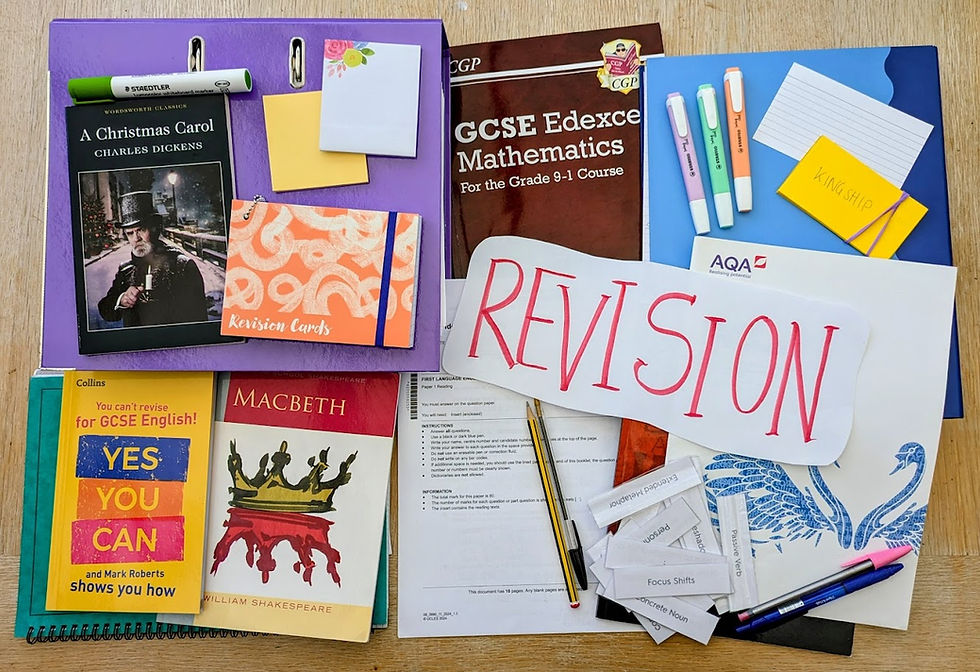
It is the Tuesday of Half-Term.
If you are reading this feeling a knot in your stomach because you planned to start revising yesterday - and didn't - please stop and take a breath.
You are not alone.
We have roughly 10 school weeks left after this break before the GCSE exams start.
I know the pressure to make the most of the holidays is massive right now.
You feel like everyone else is studying 8 hours a day while you are just staring at the wall.
For students who struggle with organising thoughts and getting started, this half-term pressure doesn't lead to productivity. It leads to revision paralysis - and the worst thing of all, burnout.
So, let’s strip this back.
What Actually Is "Revision"?
It sounds obvious, but let's define it.
Revision isn't just staring at a book until your eyes glaze over.
Revising means going over things you have learnt to consolidate them in your long-term memory so you can use them during your exams.
It is simply the process of keeping things fresh in your mind so they are there when you need to reach for them.

Knowing how to do that without getting overwhelmed is the hard part, so here is my advice for keeping revision simple.
1. The Golden Rule
You cannot revise what you haven't learnt.
If we lived in a perfect world, you would have finished every topic in school already.
But we don't. Usually, your teacher will tell you when you've gone through everything. If they haven't told you, you can always ask!
Don't panic about the stuff you haven't covered in class yet. Focus on learning it first. Once you have learned it, then you can revise it.

2. Comparison is the Thief of Joy
Let’s ignore the pressure from social media and the people revising 4 hours a day.
Do not compare your Chapter 1 to someone else's Chapter 20.
If your friend is revising 4 hours a day, good for them.
But what's good for you? You need to do what works for your brain.
3. Use What You Already Have
If your school gave you a revision workbook, go through it.
If you spent hours making flashcards, please actually use them.
Flip them over. Test yourself. If they are just sitting in a pile, they are pointless.
If your parents bought you a revision guide, open it up and try some questions.
Most importantly, do your homework - your teachers are probably giving you revision activities already.

4. Passive Revision Counts
You probably know by now that the best way to revise is by actively using the information, testing yourself on the content and challenging yourself to actively recall from your memory. This is true.
But, some days you don't have the energy for active revision, and that's okay.
I'm here to remind you that passive revision still counts, and sometimes it is all you can manage.
So here are some examples:
Play some online Maths games. I love picking something random on Transum. Divided Islands on BBC Bitesize is another personal favourite. MathsBot is a little less colourful but I enjoy the timed challenges.
For English Language, you are going to be given unknown extracts. It's easy to forget about non-fiction so get prepared by reading an article once in a while. Listen to a TED talk.
Always be reading, listening to, or watching your Literature texts. Listen to an audiobook while walking to school (most of the classics are on BBC Sounds). Watch the movie version (or several). Immersion in your set texts really helps.
5. Have a Plan
I know, I know. Making a plan is easier said than done.
Planning can be difficult. Staring at a blank calendar or trying to decide what to do first often leads to doing nothing at all.
So, I'm going to break down some simple revision plans for GCSE Maths and English. I’ll do the planning for you, so you can just focus on the doing.

6. Ask for Help
You don't have to struggle in silence.
Find a video on YouTube.
Ask your mum to test you from your school book.
Ask your teacher for feedback and help when you don't understand.
AI can be helpful if you give it the right prompts (I'll share more about this soon!)
If you have time, you could try tutoring. It definitely counts as double revision! ;)
7. Finally: SLEEP
The most productive way to revise is rest. Go for a nap. Take a break.
Your brain needs sleep to store the information you've learned.

How does that sound?
If it's still too much - I understand.
Just take the next smallest step. Watch a YouTube video or have a nap. Your choice.
Come back tomorrow for a simple revision plan for GCSE Maths.


Comments